SLRD Initiative
Grown by Farmer Collectives, Traced to the Buyer
Aromatic and Medicinal Crops from Farm to Market
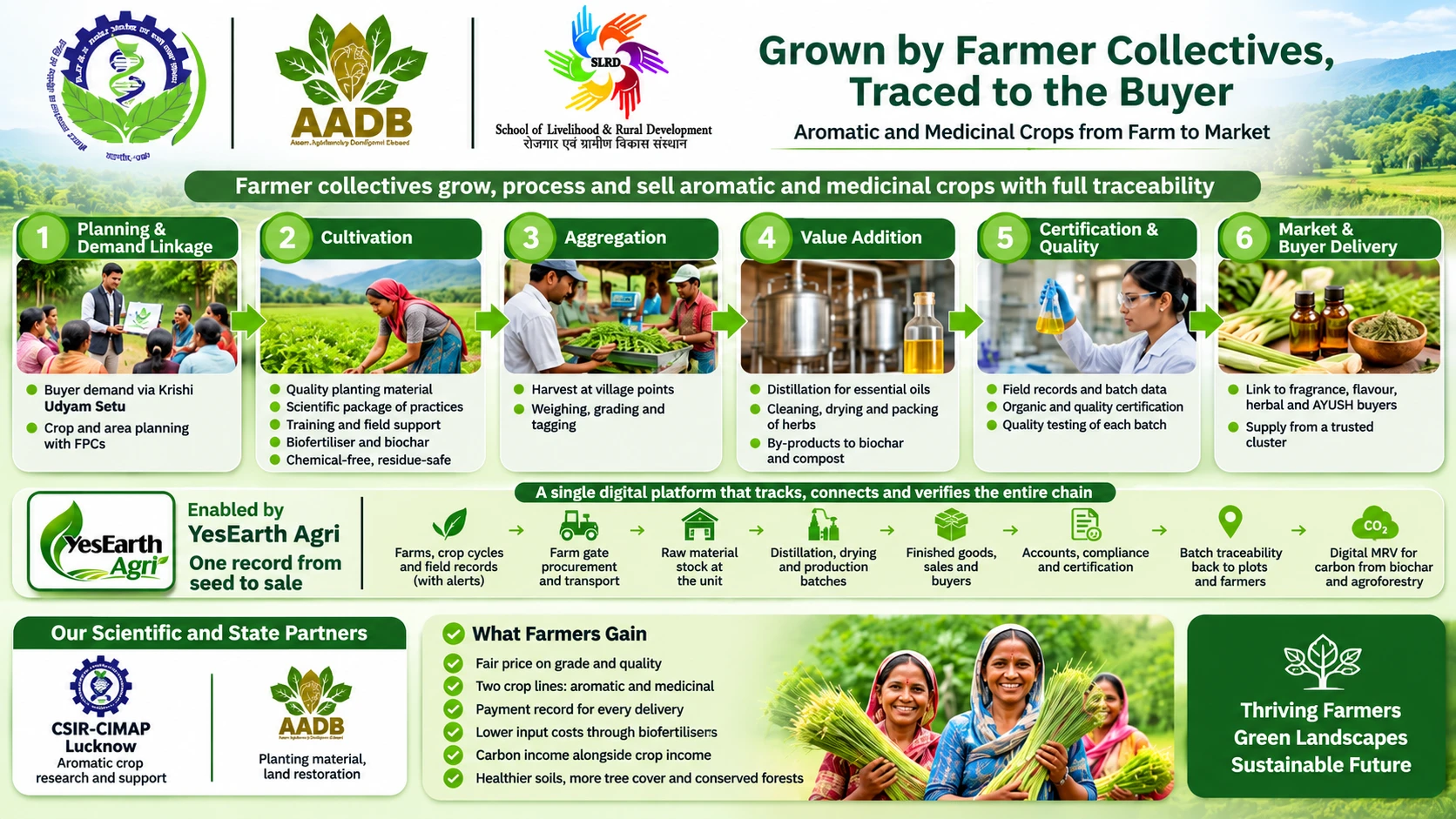
School of Livelihood and Rural Development works with Farmer Producer Organisations and Farmer Producer Companies to grow, process and sell aromatic and medicinal crops. Farmers own the collective. The collective holds the produce until the sale. YesEarth AGRI records every step from planting to buyer, so you see where each batch of oil or herb came from and how the cluster processed the produce.
Over 23 years, we have built producer institutions across North East and Central India, and today 100+ FPOs and producer institutions work with us. Aromatic cultivation runs in Udalguri, West Karbi Anglong and Dima Hasao in Assam, Mokokchung in Nagaland and Unchehara in Satna, Madhya Pradesh. Lemongrass and Java citronella are the lead aromatic crops.
Medicinal herbs give a second crop line to the same collectives. We focus on tribal households living around forests, wildlife reserves and eco-sensitive zones, where restrictions on land use leave few income options. Aromatic and medicinal herbs fit within those rules. Families earn from the land while the forest around them stays protected.
Our scientific and state partners
CSIR-Central Institute of Medicinal and Aromatic Plants (CSIR-CIMAP), Lucknow
School of Livelihood and Rural Development has signed an MoU with CSIR-CIMAP to develop aromatic crops as part of our agroforestry work. The MoU covers cultivation, value addition and market connect. Our field teams have trained at CSIR-CIMAP, and the institute's scientists back our crop and processing decisions.
Assam Agroforestry Development Board (AADB)
AADB has signed an MoU with a consortium led by School of Livelihood and Rural Development, with the Global Association of MSMEs and YesEarth Eco Consulting as members. The collaboration covers:
- Integrated biochar, biofertiliser and essential oil units run with local FPCs in Udalguri, Karbi Anglong and Dima Hasao
- Aromatic grass and bamboo plantations to restore degraded and deforested land
- Planting material support
- Watershed development
- Agarwood cluster development
Joint work under both MoUs starts in Udalguri, Tamulpur and Darrang. The first activity is farmer awareness and training on aromatic crop cultivation and value addition.
How the chain works
Cultivation. We match crops to elevation, soil and water, from 85 m above sea level in Udalguri to 1,450 m in Mokokchung. Farmers receive quality planting material, a package of practices and field training for each aromatic and medicinal crop. Biofertiliser and biochar from our integrated units replace chemical inputs and build soil carbon. Chemical-free growing matters most for medicinal herbs, where buyers test for residues. CSIR-CIMAP supports crop selection, cultivation practice and processing, and AADB supports planting material and land restoration in Assam.
Aggregation. The collective gathers the harvest at village collection points. Each lot gets weighed, graded and tagged to the farmer and the plot. Farmers are paid on the recorded weight and grade.
Value addition. Distillation units owned by the FPC turn aromatic leaf into essential oil close to the farm. Medicinal herbs are cleaned, dried, graded and packed at the cluster, so they reach the buyer with their quality intact. Spent biomass goes back to the field as biochar and compost. The processing margin stays in the cluster.
Certification. Field records, input logs and batch data give the evidence base for organic and quality certification. Each batch of oil and herb is quality tested before sale.
Market connect. We link collectives to buyers in fragrance, flavour, personal care, herbal and AYUSH products. Krishi Udyam Setu, our demand-led market access programme with the Global Association of MSMEs, brings buyer demand to the cluster before planting begins. Buyers source from a known cluster with a verified record.
YesEarth AGRI: one record from seed to sale
YesEarth Eco Consulting built YesEarth AGRI as the digital system behind the chain. Field teams capture data offline in the village and sync once the network returns. The platform tracks:
- Farms, crop cycles and field records, with alerts for field teams
- Farm gate procurement and transport
- Raw material stock at the unit
- Distillation, drying and production batches
- Finished goods, sales and buyers
- Accounts, compliance, certification and traceability
Each batch of oil or herb links back to the plots and farmers who supplied the harvest. A buyer receives the batch record showing the source cluster, the inputs used and the processing history. The same records feed digital MRV for carbon from biochar and agroforestry, which gives the collective a carbon income alongside crop sales. YesEarth AGRI is working in the field and is being rolled out across five FPCs.
What farmers gain
- A price set on grade and quality instead of a distress sale to traders
- Two crop lines, aromatic and medicinal, from the same collective
- A payment record for every delivery
- Lower input costs through biofertilisers made in the cluster
- Carbon income alongside crop income
- Healthier soils, more tree cover and conservation of forests and local ecosystems