Date: 26th–29th August 2025
Venue: ICAR–KVK, Umiam, Ri-Bhoi District, Meghalaya
Organised by: School of Livelihood and Rural Development (SLRD)
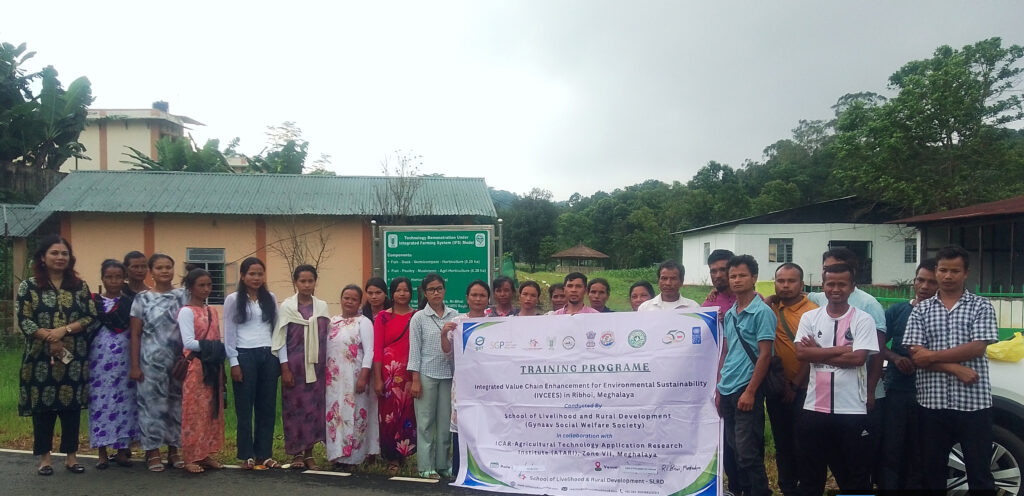
The School of Livelihood and Rural Development (SLRD) successfully organised a four-day training programme on Crop Diversification from 26th to 29th August 2025 at ICAR–KVK, Umiam, Ri-Bhoi District, Meghalaya. The programme aimed to equip farmers with practical knowledge and skills on sustainable and climate-resilient farming practices, with a strong focus on crop diversification, animal husbandry, and integrated farming systems.
The training covered crop management practices for millets, paddy, and maize, along with sessions on animal sciences, particularly piggery and poultry farming, as important income-generating enterprises. Farmers were introduced to the significance of crop diversification through intercropping, crop rotation, and the use of resilient varieties to enhance productivity, soil health, and food security. Special emphasis was also placed on the Integrated Farming System (IFS) approach, including paddy–fish integration, demonstrating how crops, livestock, and fisheries can be combined to optimise resources, reduce risks, and improve livelihoods.
Objectives of the Programme
- To build the capacity of farmers on crop diversification, with emphasis on millets.
- To enhance knowledge on animal sciences, particularly piggery and poultry farming, as supplementary income-generating enterprises.
- To introduce and promote the Integrated Farming System (IFS) for efficient resource use and climate-resilient farming.
- To demonstrate the benefits of paddy–fish integration for improving productivity and nutrition.
- To encourage adoption of intercropping, crop rotation, and crop–livestock–fish integration for improved soil health and sustainable livelihoods.
Programme Overview
The training programme was conducted through a series of expert-led technical sessions and practical field visits, ensuring a balanced blend of classroom learning and hands-on exposure. Farmers actively participated in interactive discussions, demonstrations, and field-based learning modules throughout the four days.
Experts from ICAR–KVK, Umiam, shared insights on sustainable crop diversification practices, including intercropping, crop rotation, mixed cropping, and relay cropping. Emphasis was laid on the cultivation and management of millets, paddy, and maize, highlighting their role in enhancing soil fertility, improving nutrient use efficiency, reducing pest incidence, and increasing farm resilience to climate stress. Special attention was given to pest and disease management strategies, timely weeding, quality seed selection, appropriate spacing, compost use, and sustainable harvesting practices.
The programme also included extensive training on animal sciences, focusing on piggery and poultry farming as profitable supplementary enterprises. Farmers were oriented on scientific breeding, feeding, housing, healthcare management, and biosecurity measures. Exposure visits and demonstrations introduced participants to improved and hybrid breeds such as Kadaknath, Srinidhi, and Vanaraja, known for their adaptability, disease resistance, and income-generating potential.
In addition, sessions on the Integrated Farming System (IFS) highlighted the importance of integrating crops, livestock, and allied activities to maximise resource utilisation, recycle farm waste, ensure year-round income, and enhance sustainability. Farmers learned about paddy–fish integration and integrated paddy farming models involving fish, poultry, and swans, which support natural pest control, nutrient recycling, and dual income generation.
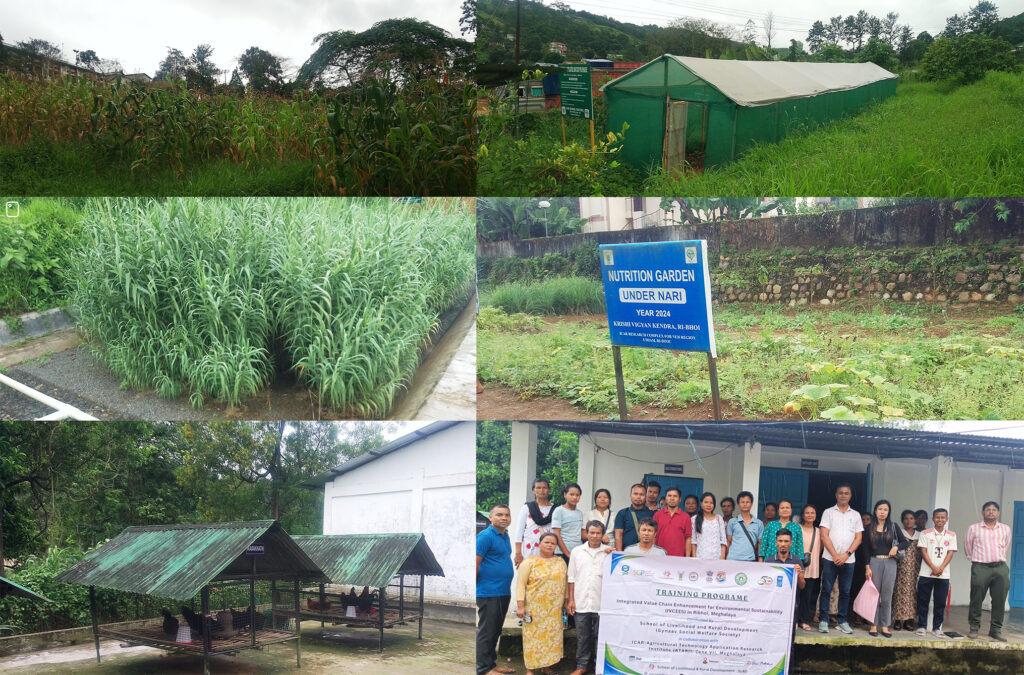
Practical field visits were conducted to ICAR–KVK demonstration fields, poultry units, multiplication farms, polyhouse nurseries, and integrated farming system plots. These visits enabled farmers to observe real-time demonstrations on crop management, nursery raising, seed multiplication, poultry and piggery management, and paddy–fish integration, helping them connect theoretical knowledge with practical applications.
The programme concluded with a field demonstration on integrated farming practices and the distribution of participation certificates to farmers in recognition of their active involvement and learning.
Participants
The programme was attended by 29 farmers, including 20 women and 9 men, from THAD FPO, Ri-Bhoi District. Participants actively engaged in both theoretical sessions and practical field visits, gaining hands-on exposure to crop management, piggery, poultry, and fisheries integration.
Key Outcomes and Achievements
- Enhanced practical and theoretical knowledge on crop diversification, animal husbandry, and integrated farming systems.
- Improved understanding of intercropping, crop rotation, and pest management for millets, paddy, and maize.
- Increased awareness of piggery and poultry farming as profitable supplementary enterprises.
- Exposure to paddy–fish integration and integrated farming models for efficient resource use and multiple income generation.
- Strengthened capacity to adopt scientific techniques in livestock breeding, feeding, housing, and healthcare.
- Increased motivation among farmers to adopt sustainable and climate-resilient farming practices.
Conclusion
The four-day workshop on crop diversification and integrated farming systems proved highly beneficial for participating farmers. Through a balanced combination of classroom sessions and field demonstrations, farmers gained valuable insights into sustainable crop management, animal husbandry, and fisheries integration. The exposure to scientific techniques and integrated models has strengthened farmers’ confidence to adopt diversified, resource-efficient, and climate-resilient practices, ultimately contributing to improved productivity, income, and food security in their communities.