Date of Activity: 12/06/2026
Associated Partners: UNDP/ SGP-07, SELCO Foundation

Nestled in the green hills of the Marngar–Umling Block of Ri Bhoi District, Meghalaya, Madanheh Village has always depended on agriculture for its livelihood. For generations, families cultivated crops such as turmeric, pineapple, paddy, maize, and vegetables using traditional farming methods. Agriculture was not just an occupation; it was a way of life that connected the community to its land and culture.
Among the crops grown in the village, turmeric held special importance. The fertile soil and favourable climate produced high-quality turmeric with excellent market potential. Yet, despite their hard work, farmers received only modest returns. The reason was simple: turmeric was sold in its raw form. After harvest, farmers cleaned the rhizomes and sold them to traders, who carried out processing and earned the larger share of profits. The village had neither the equipment nor the infrastructure needed to process turmeric into value-added products.
In Meghalaya’s matrilineal society, women play a vital role in agriculture, contributing to every stage of turmeric cultivation, from planting and weeding to harvesting and post-harvest handling. However, despite their significant involvement, limited opportunities for value addition meant that much of the economic benefit remained outside the village, resulting in modest incomes for farming households.
Recognizing these challenges, the Marngar Cluster Farmers Producer Co-operative Society united around 250 farmers, mostly women, with the goal of improving livelihoods through collective action and value addition. To turn this vision into reality, the cooperative required processing infrastructure and a reliable source of energy, which was made possible through the solar-powered intervention.
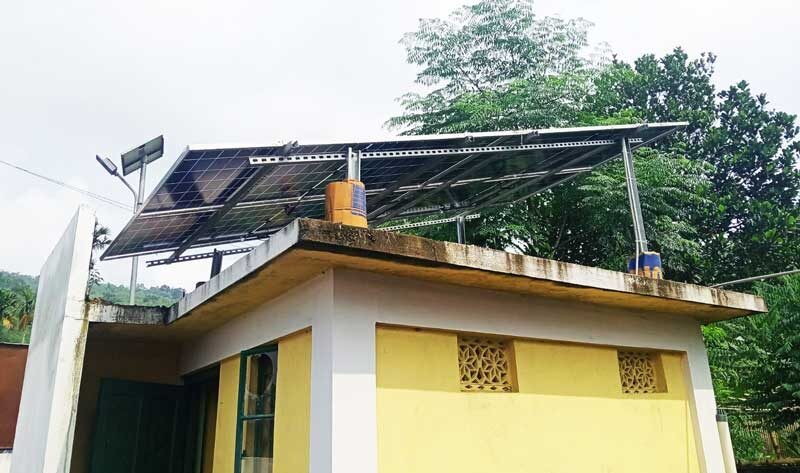
A transformative opportunity emerged through the Integrated Value Chain Enhancement for Environmental Sustainability (IVCEES) Project, implemented by SLRD and supported by UNDP SGP-07 and co funded by SELCO Foundation, which provided the Marngar Cluster Farmers Producer Co-operative Society with a turmeric processing unit and a 2.3 kW solar power system. The facility enables farmers to wash, slice, dry, and package turmeric locally, creating opportunities for value addition and higher income. The solar-powered system provides a reliable and clean source of energy, reducing dependence on grid electricity and lowering operational costs. As a result, the processing unit can function efficiently while supporting sustainable and climate-resilient rural livelihoods.
Today, the story of Madanheh Village is one of transformation. Farmers who once depended on low-value sales of raw turmeric can now undertake local processing and value addition, significantly increasing product value, reducing post-harvest losses, and enhancing overall farm incomes. Women have emerged as key participants in processing and enterprise management. The cooperative has gained confidence to explore branding, packaging, and new markets. Most importantly, the community has discovered that sustainable energy can unlock economic opportunities that were previously beyond reach.
The sun that once nourished their fields now powers their future. Through the support of the IVCEES Project implemented by SLRD and supported by UNDP SGP-07, the solar-powered turmeric processing unit has become a catalyst for change—improving incomes, empowering women, reducing costs, and creating a more resilient agricultural economy. For the farmers of Madanheh Village, it is not merely a technological intervention; it is a pathway toward prosperity, sustainability, and self-reliance.